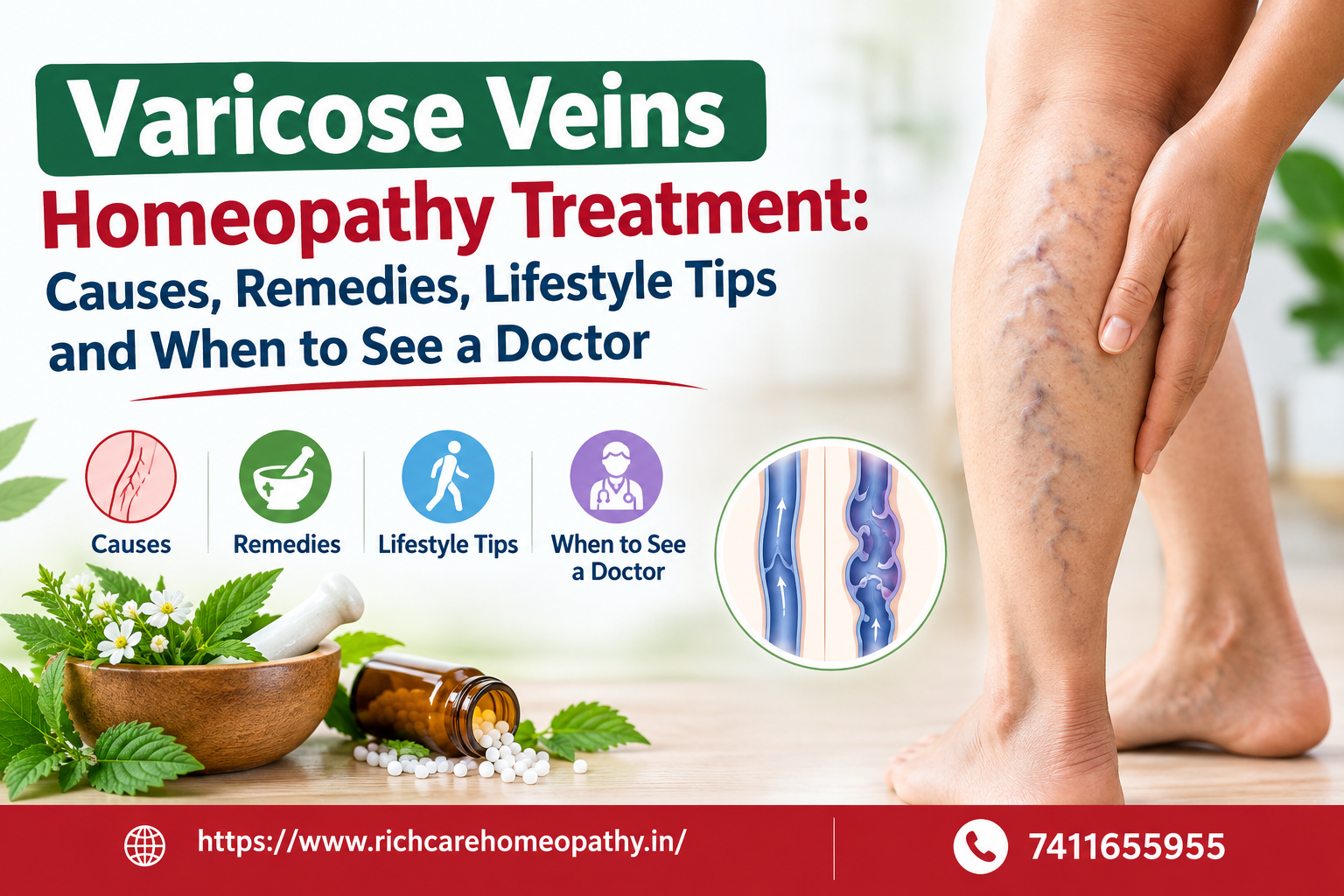
Swollen, twisted, bluish veins on your legs are not just a cosmetic problem. Varicose veins can cause pain, heaviness, itching and night cramps, and many people look for gentle options before thinking about surgery. One approach people often explore is varicose veins homeopathy treatment.
In this guide, you will learn what varicose veins are, why they happen, which homeopathic medicines are traditionally used, what lifestyle changes help, and when you should not delay seeing a doctor.
Varicose veins are enlarged, twisted veins that usually appear on the legs and feet. Veins have small one-way valves that push blood upward towards the heart. When these valves weaken or get damaged, blood flows backward and pools in the vein. The vein then stretches, swells and becomes visible under the skin.
Smaller, web-like versions are called spider veins. They are usually less painful but may be an early sign of venous weakness.
Varicose veins rarely have a single cause. Common contributing factors include:
Homeopathy is a system of medicine based on the principle of "like cures like". Homeopathic practitioners usually do not choose a medicine only by the name of the disease. They study the person as a whole, including the symptoms, the type of pain, what makes it better or worse, temperament, lifestyle, thirst, sleep and other health complaints.
That is why two people with varicose veins may be given two different medicines. Homeopathic care usually aims to:
Important: Scientific evidence for homeopathy in varicose veins is limited, and results vary from person to person. It should be seen as a complementary option rather than a guaranteed cure, and it should never replace proper medical evaluation.
The medicines below are traditionally mentioned in homeopathic literature for vein-related complaints. They are listed for information only. Please do not self-medicate. Potency and dose should be decided by a qualified homeopathic doctor after a full case-taking.
Often used when veins feel sore, bruised and tender, with a sense of fullness and soreness along the vein.
Traditionally considered for varicose veins with heaviness, symptoms that get worse in warmth and in a closed room, and relief in open air.
A well-known remedy in homeopathic books for hard, knotty veins and weak connective tissue.
Used when legs feel bruised, sore and tired, with a sensation as if the bed is too hard.
Mentioned for veins with a bursting sensation, especially when the legs hang down, and relief when the legs are raised.
Often considered where circulation is sluggish, with bluish skin, coldness and weakness of the legs.
Traditionally used for bluish-purple veins with sensitivity to touch and tight clothing.
Used when veins are congested and there is aching in the lower back, along with a feeling of heaviness.
Whatever treatment you choose, daily habits make a big difference.
Varicose veins are often harmless, but they can sometimes lead to complications. Consult a doctor or vascular specialist without delay if you notice:
If you are pregnant, diabetic, or already taking blood thinners, always discuss any new treatment with your doctor first.
Homeopathy may help some people with symptoms such as pain, heaviness and swelling, but there is no strong scientific proof that it can remove existing varicose veins. Outcomes differ from person to person.
There is no single best medicine. Hamamelis, Pulsatilla, Calcarea Fluorica and Arnica are commonly discussed, but the right medicine depends on your complete symptom picture and must be chosen by a qualified practitioner.
It depends on how long you have had the problem, its severity and your overall health. Chronic conditions usually need patience and regular follow-up.
Homeopathic medicines are generally considered safe when taken under professional guidance, but a proper diagnosis is essential so that serious complications are not missed.
Mild to moderate cases are often managed with lifestyle changes, compression stockings and medicines. Procedures such as sclerotherapy, laser or radiofrequency ablation are options in more advanced cases, as decided by a specialist.
Yes, they can, especially if risk factors like prolonged standing, weight gain or constipation continue. Long-term lifestyle care is important.
Varicose veins develop slowly, so early attention matters. A combination of regular movement, a healthy diet, leg elevation and professional guidance can help you stay comfortable. Many people choose varicose veins homeopathy treatment as a gentle, complementary option, but it works best alongside proper diagnosis and regular check-ups.
If your symptoms are increasing, consult a qualified doctor, get a vein examination, and choose the treatment plan that is safest for you.
Book Appointment -Dr.Shashidhar-MD(HOM): For Further Medical Consultation Call or WhatsApp On +91-7411655955 to Book An Appointment.
Disclaimer: This article is for educational purposes only and is not a substitute for professional medical advice, diagnosis or treatment. Always consult a qualified healthcare provider before starting any treatment.
We, Rich Care Homeopathy, situated at Malleswaram, Bangalore, our dedication to excellence, compassion and innovation is rooted in our devotion to the art and science of healing which supports every aspect of our mission and to the care we give to our patients.
 Malleswaram, Bangalore, Karnataka 560003
 Bangalore